- ZWIĄZEK BUDDYJSKI BENCIEN KARMA KAMTSANG POLSKA
-

- Benchen Karma Kamtsang Buddhist Association Poland



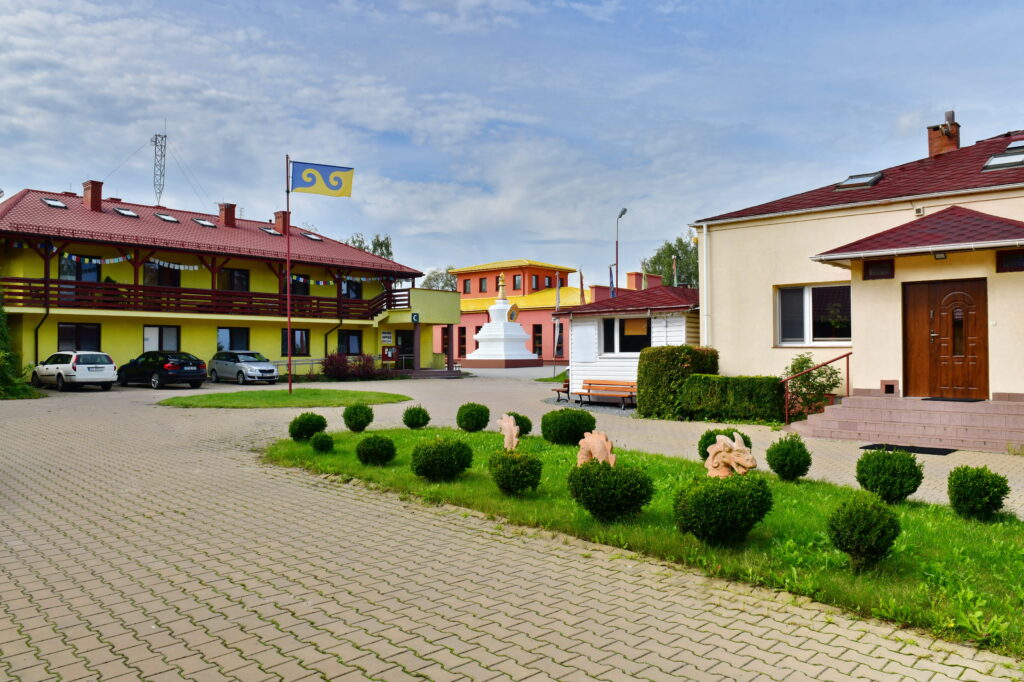
The Benchen Karma Kamtsang Centre in Grabnik is the headquarters of the Association. Seminars, meditation practices and studying of classic texts are regularly held here by Polish and Tibetan lamas.
The Centre is located in Jaktorów, approximately 40 km from Warsaw. It offers the serenity of a secluded place and at the same time easily accessible.
The presence of Lama Rinchen (a Polish student of Ven. Tenga Rinpoche) as well as other lamas living in the Centre or visiting, gives the opportunity to receive advices, empowerments and instructions for practice. The library collection is available on the premises. One can also find texts and other materials for Buddhist practice.
“Benchen Drubde Osal Ling in Poland”, the three year retreat centre, was launched in 2009. You may also complete an individual retreat in adjusted trailers remote from the main building. If you are interested in an individual retreat, please consult with Lama Rinchen and book a date in the office.
The Buddhist Culture Centre, co-financed from European Union funds, was created here in 2010. We are building also a temple (named by His Eminence Sangye Nyenpa Rinpoche: Lhakhang Jinlab Trinpung – Clouds of Blessings Temple), a stupa with Kyabje Tenga Rinpoche’s relics and a kitchen.
The office is open from Tuesday to Sunday: 10:00 am – 1:00 pm and 2:00 pm – 5:00 pm. Closed on Mondays.
Our temple – Lhakhang Jinlab Trinpung
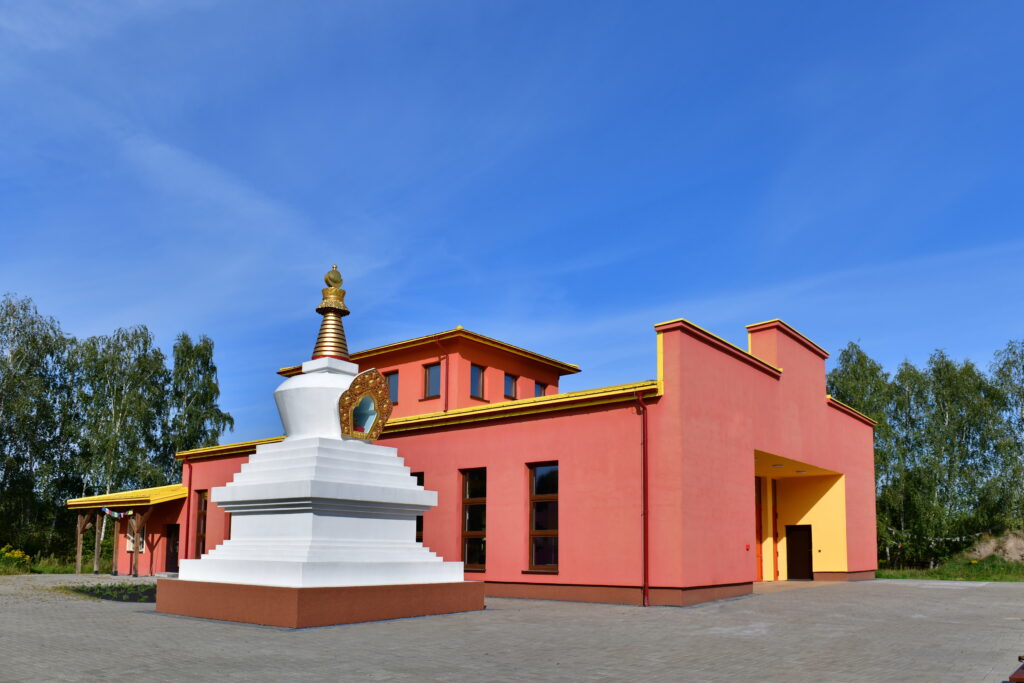
From the very beginning of the Buddhist Centre in Grabnik we harboured a genuine wish to build a temple (Tib. lhakhang) here. Kyabje Tenga Rinpoche has always encouraged us to do so. Unfortunately, circumstances were not favourable and it took a while before all conditions needed to launch the construction came together.
The final decision was made in the summer of 2011, during the second Kagyu Monlam in Poland. Then, Kyabje Tenga Rinpoche gave a speech which moved the hearts of all listeners. He foretold that the temple which would be built here through the combined effort of our entire sangha, would last for kalpas, bringing unsurpassable benefit and contributing to the development of the Dharma. Rinpoche also performed the ceremony of consecrating the site intended for construction (Tib. sa chok) and offered the first donation thus inspiring others to be generous.
Here are Rinpoche’s words:
“In the near future we are planning to build a temple at Benchen Karma Kamtsang Centre in Grabnik. This temple will remain here for many kalpas. During its existence many Dharma activities will be performed there by lamas, khenpos and Buddhist masters, bringing much benefit to a great number of beings.
All the disciples will be able to gather there to practice and share Dharma together, and because they will receive a lot of empowerments and teachings there, it will become a place where a great deal of merit will be accumulated. This lhakang, or temple, will remain here for a very long time, during which it will definitely help us to accumulate a great deal of merit. In other words, performing Dharma activities within the walls of this temple will bring much benefit and accumulation of merit.
As an example of the benefits brought about by building a monastery or a temple, we can take the case of the first Karmapa, Dusum Khyenpa. He came into this world 900 years ago. He was instructed by his master, Gampopa, to go to Kampo Gangra to practice there in retreat. Karmapa spent seventeen years there and established a small monastery. This monastery, known as the first seat of Karmapa, is considered the mandala of body. Then, according to Gampopa’s prophecy, Karmapa went to a place called Karma Gön where he spent six years and established another small monastery. This is the second seat of Karmapa and it is considered the mandala of speech. He finally went to Tsurphu, where he established the main seat of Karmapas, considered the mandala of mind. Even though 900 years have passed, all the monasteries that he established still remain. And although at times in the past some of these monasteries were destroyed, they were rebuilt and are still there performing activities that bring great benefit to all sentient beings.
In the same way, if we managed to build a temple here in Poland at the site of Benchen Karma Kamtsang Centre, this temple will not be destroyed. It will remain and will not be empty for many, many generations, for hundreds of years, and during this time many important and precious Dharma activities will be performed there. The merit accumulated by all those who will help build and maintain the temple will be great and will continuously multiply. Therefore, I request that all Dharma brothers and sisters contribute and help build the temple in whatever way they can. Please, keep that advice in your hearts.”
Lhakhang, literally “House of Gods”, is the Tibetan name for a shrine-hall, that is a room or building where religious ceremonies and practices are held. Its focal point is the altar. Sometimes within one monastery there are several different shrines halls. The entire monastic compound including the shrine halls and monks’ quarters is called “a gompa”. However, nowadays in Western Dharma centres, this term is often used for the shrine room itself.
The custom of giving separate names for lhakhangs, different from the names of the entire monasteries, has existed in Tibet since centuries. For example, the main shrine hall in Benchen Monastery in Tibet has its own name, independent from the name of the monastery, as does the lhakhang within the Benchen Shedra Institute in Pharping.
Following this tradition, during his stay in Nepal in October 2016 Lama Rinchen requested His Eminence Sangye Nyenpa Rinpoche to give a separate name to our lhakhang in Grabnik. Rinpoche enthusiastically agreed and decided to call the shrine Lhakhang Jinlab Trinpung – Clouds of Blessings Temple.
This is an exceptionally auspicious name. This is how one of the main temples of the Khadampa tradition was called, from which the Kagyu school draws many teachings and inspiration.
The Buddhist Centre in Grabnik is called Benchen Karma Kamtsang Ling Grabnik and within it separate names were given to:
the shrine: Lhakhang Jinlab Trinpung (Clouds of Blessings Temple)
the three-year retreat: Drubkhang Benchen Drubde Osal Ling (Clear Light Benchen Retreat Centre).
What is done
Already in autumn 2011 we were offered a structural design of the shrine hall which was subsequently approved by both Rinpoches: His Eminence Sangye Nyenpa Rinpoche and Kyabje Tenga Rinpoche.
We obtained the building permit on 27 September 2012 and the construction went underway in October. The foundations and walls grew quickly.
On 7 August 2013 we built in a brick which was much earlier consecrated for this purpose by His Holiness the Dalai Lama requested by Lama Rinchen during his visit to Warsaw in 2000. His Holiness personally wrote the three sacred syllables OM AH HUNG on the brick. It was placed in the wall which now is the background for the main Buddha statue; it is installed at the level of the statue’s heart.
During the summer course in 2013 His Eminence Sangye Nyenpa Rinpoche offered to sponsor the main statue for the shrine, one of Sakyamuni Buddha with all surrounding ornaments. The statue ordered by Rinpoche was made in Nepal.
Thanks to the generosity of the benefactors from our sangha, the roofed shell of the building was ready by autumn 2013. In the beginning of April 2014 we purchased and fit in all the windows.
In spring 2015 the lhakhang was plastered on the outside and covered with the first layer of paint. The entire surface of the floor was insulated and covered with a layer of concrete. The structure supporting the Buddha statue was built and covered with granite.
In the last week of February 2015 the boxes containing the parts of the Buddha statue arrived from Kathmandu to Poland. Assembling and filling the statue began in mid-May. Lama Gelek Paljor from Benchen monastery in Kathmandu – the assistant of Kyabje Tenga Rinpoche for many years, supervised them. Owing to the contribution of many people we prepared all the necessary materials and substances needed to fill the statue in a relatively short time. We placed the ornaments, filled and set the Buddha statue in place just before the arrival of Sangye Nyenpa Rinpoche.
We were also offered a huge thangka depicting the Refuge Tree. It stands out not only due to its size, but also because of the precision of the details.
On Sunday, 27 September 2015, His Eminence Sangye Nyenpa Rinpoche performed the ceremony of consecrating the Buddha statue (Tib. rab-ne). Rinpoche, who sponsored not only the production but also the transport of the statue to Poland, in his immense kindness, ordered in Nepal and promised to send to Grabnik, two additional statues which should accompany the Buddha statue (these are statues depicting the two main disciples of the Buddha: Shariputra and Maudgalyayana) as well as traditional ornaments for Buddha’s throne made of granite. Rinpoche also offered a canopy to be placed over the Buddha’s head and brocade ornaments for the pillars. The brocades are already arranged in the shrine.
In the beginning of 2016 the heating system was installed. The last layer of thermal insulation and OSB boards were placed on the floor. In the future, we plan to finish the floor with a layer of quality wood, however at the moment there are much more urgent things requiring expenditure.
The sidewalls of the altar we also covered with granite. We plan to add traditionally ornamented wooden niches flanking the Buddha statue. There will be more statues (including 21 Taras), as well as holy texts containing the entire Buddhist canon – Kangyur and Tengyur.
In Autumn 2016, two additional statues offered by Sangye Nyenpa Rinpoche, came to Poland.
They have been gilded, assembled and thoroughly filled with mantras, life trees and other substances. In December, specially educated monk, Yeshe Chophel, painted the faces of the three statues with gold which was also offered by Rinpoche. In Spring 2017, metal ornaments on the Buddha throne were painted and applied.
Meanwhile, we continued with the works around the building. Cloakrooms by the side entries to the temple as well as the room where tormas are made have been finished. In Summer 2017 in June, we managed to paint the elevation of the building claret and to cover the roof with yellow sheet metal. Works connected with gutters and draining were also included. At the same time, we also finished adorning the Buddha throne with gemstones.
In autumn 2017, the square in front of the main entrance and around the whole building was hardened. Before winter we had managed to lay around 90 % of that ground with cobblestones. The remaining works, which are the rest of the access road, the path to the building ‘A’, as well as splitting and sandblasting, was completed in 2018. In 2019, after the cobblestones had grounded, we started to correct those places where the cobbles needed to be levelled.
In summer 2019 we purchased and set the main, large entrance to the temple. It gives the possibility to open only small door for everyday use and full door for big seminars, when we will extend the shrine hall using additional tent.
In spring 2020 the supply and exhaust air handling unit was installed in the temple.
In the spring of 2023 a vinyl floor was laid in the temple and air conditioning was installed.
All of the above work was carried out only through the great effort and generosity of our Lamas and Benchen community – not only in Poland. We express our heartfelt gratitude to everyone who contributed to this unique enterprise.
We are especially grateful to Venerable Kyabje Tenga Rinpoche, without whom we would never have started to develop the temple; and His Eminence Sangye Nyenpa Rinpoche – the initiator and main sponsor of the statue in Grabnik, as well as Sangter Rinpoche, whose presence here inspires our efforts.
We would also like to thank Lama Yeshe Gyatso who, following Rinpoche’s request, supervised the work on the statue in Nepal, as well as Lama Gelek Paljor and Lama Sherab Wangchuk – it would not have been possible to assemble and fill the Buddha statue without their knowledge, experience and great involvement.
Our thanks also go to those who tirelessly worked day in day out, often giving up their night’s rest. We also thank those whose financial support made it possible to bring the construction thus far. Great donations as well as small amounts offered were very helpful and appreciated. Multiplied by the number of benefactors they fruition in tangible results. Without you, we would not have been able to progress at this pace!
This shrine hall is the creation of all of you, those who offer from the bottoms of their hearts what they can: money, labour, kind words and good wishes.
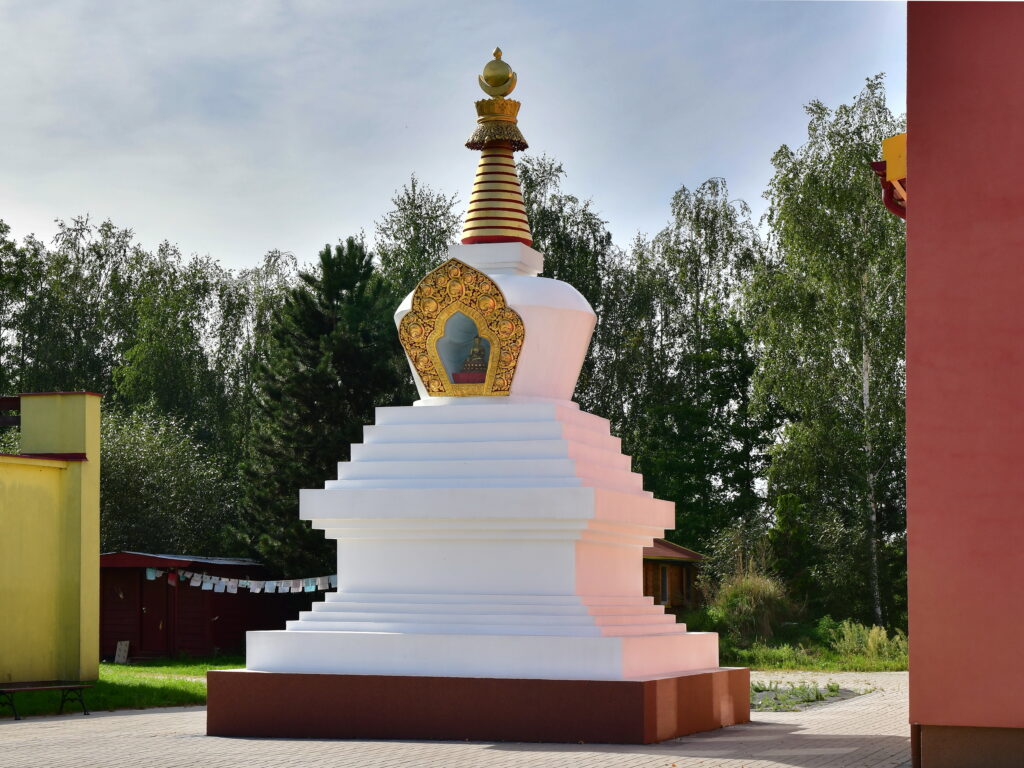
Kyabje Tenga Rinpoche’s relics in Grabnik
Kyabje Tenga Rinpoche, our precious Teacher, passed into Parinirvana in the spring of 2012. He remained in the post-mortem meditation called Thugdam for 108 hours (four and a half days).
Out of his great compassion, Rinpoche left particularly precious relics after the cremation of his body, so that we remember that he still is with us, cares for us and guards us. His heart, tongue and a part of spine were found intact and were later put inside Rinpoche’s statue in the monastery. It is said that if a master, after his cremation, leaves the heart (symbol of mind), tongue (symbol of speech) and symbols of body untouched by the fire, which happens very rarely, it is a sign of his unusual, immense compassion.
Other relics were placed in stupas built especially for this purpose in Benchen monastery in Kathmandu and in Parping. Part of the relics were presented to the monastery in Rumtek, where Tenga Rinpoche presided as Vajra Master for many years. Yet another part was offered to various Benchen centres worldwide, including our Benchen Karma Kamtsang Centre in Grabnik.
Kyabje Tenga Rinpoche’s relics were brought to Grabnik in August 2012. In order to preserve them in a respectful manner in a place where Rinpoche’s students would be able to pay homage to them, we constructed the proper stupa to contain them. It is about 7.5 metres high.
The benefits of building a stupa
The benefits of building stupas are countless. They are mentioned in both sutras and tantras. The texts promise long life in health and prosperity, good future rebirth and swift Enlightenment.
You can find more information in articles on the benefits of building stupas and paying homage to them.
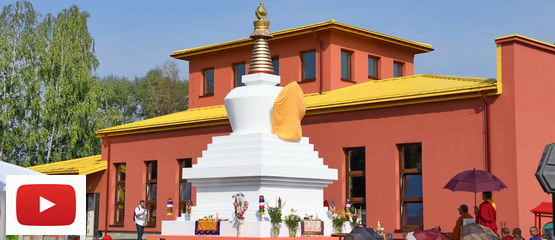
Stages of building stupa in Grabnik
In August 2013, His Eminence Drubwang Sangye Nyenpa Rinpoche set out the site for the stupa and carried out the ceremony of consecrating the ground for construction (sa chok in Tibetan).
Since the spring of 2015 the stupa has been growing rapidly. Thanks to the enormous support of our Buddhist community, we were able to prepare the numerous substances and materials necessary to fill this sacred edifice, such as a set of the holy texts of Kangyur and Tengyur, several vases of the Earth Goddess and Nagas, scrolls of appropriate mantras, a sok-shing (the “Tree of Life”), which constitutes the core of the stupa and over 2,000 tsa-tsa containing the relics of Kyabje Tenga Rinpoche.
In order to make sure all works were conducted in accordance to traditional Dharmic procedures, Lama Gelek Paljor – the assistant of Kyabje Tenga Rinpoche for many years, supervised them. Despite his ailing health, he has continuously served us as an example and an inspiration through his joyful efforts and devotion.
Khenpo Osung – the main khenpo of Benchen monastery in Kathmandu – and Lama Rinchen, consecrated the tsa-tsas, mantras, texts, vases and other objects. Other Tibetan and Polish Benchen lamas also attended the ceremonies.
All of the objects were placed in the respective levels of the stupa according to proper rituals and procedures. Then a round concrete bumpa (vase) and a few of the 13 rims at the top of the stupa were made. On the 15th of November 2016 we placed “the tree of life” (sok-shing in Tibetan) with Rinpoche’s relics.
The next stage of works was applying the remaining thirteen circles on the top of the stupa as speckling the whole stupa. Meantime in Nepal, metal ornaments were ordered and transported to Poland in Spring 2017, where they were later gilded. At the end of August, the circles on the top of the stupa were painted, gilded and traditionally crowned with a sun and a moon.
In autumn 2017, it was possible to put the first layers of paint on the stupa as well as harden and pave the surrounding area. In June 2018 a gilded embellishment was mounted around the window in the bumpa.
The consecration ceremony was held by Sangter Rinpoche, Khenpo and Benchen lamas on the 19th of August 2018.
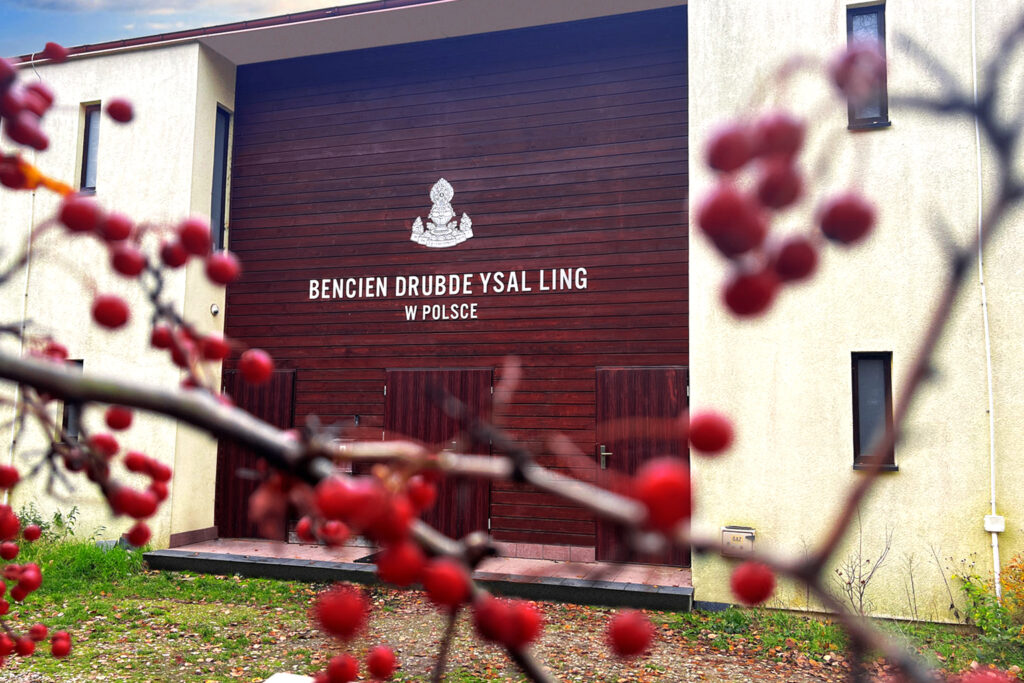
Drubkhang – The three-year retreat centre in Grabnik
Since the foundation of the Kagyu school, many of its practitioners have placed greater emphasis on intensive meditative practice rather than on elaborated theoretical studies. The most favourable conditions for meditation can be found in a secluded place, where interactions with other people are limited. This is what meditational retreats are.
The benefits of such a meditative retreat are enormous. The Buddha taught in “The Moon Lamp Sutra” (Chandra-pradipa-sutra):
“Food, drink, robes, flowers, incense and garlands
are not what best serve and honour the Buddha, the finest being of all.
Whoever, longing for enlightenment and saddened with the evilness of conditioned life,
takes seven paces towards a place of retreat
with the intention of staying there in order to benefit beings
has far greater and better merit than those who make such offerings”.
Also supporting the efforts of the retreatants is a very noble action accumulating a lot of merit. The great Tibetan yogi Milarepa wrote:
“The great yogi meditates in a rocky cave,
And benefactors bring him food.
These two interacting lead them together toward Enlightenment.
And the essence of this interaction lies in sharing merits”.
Even a one-day retreat may be very helpful. Yet, particular benefits come from the traditional three-year retreat. In Tibetan Buddhism, practitioners have undertaken it since centuries, following programmes particular to the tradition of a given monastery. In the Kagyu school, the title ‘lama’ is given to those who completed at least one three-year meditative retreat.
With time, special establishments called drubkhangs (drub – practice, khang – house, building) were developed to ensure the best conditions for those wanting to complete the three-year cycle of meditations. Many of the monasteries in Buddhist countries have their own retreat centres. Since late the 1970s several drubkhangs have also been built, in some Western countries, both in the Kagyu, and Nyingma traditions.
The Benchen Drubde Osal Ling Drubkhang in Poland (“Benchen Clear Light Retreat Centre”) was established under the auspices of the Rinpoches of Benchen Monastery: His Eminence Sangye Nyenpa Rinpoche and Venerable Tenga Rinpoche. Later, requested by both of the Rinpoches, also venerable Sangter Rinpoche began to offer empowerments, oral transmissions and teachings in drubkhang. Lama Rinchen was appointed by the Rinpoches to be the main teacher of the retreat, the so-called drubpon. In addition, lamas from Benchen monastery are invited to convey certain meditation instructions and teach the rituals. The drubkhang in Poland can accommodate sixteen practitioners: eight women and eight men.
On the 7th of September 2009 Kyabje Tenga Rinpoche led the ceremony of closing the gates of Drubkhang which inaugurated the first three-year retreat in the West in the tradition of Benchen Monastery. The first three-year retreat in the three-year retreat center “Benchen Drubde Osal Ling” in Grabnik finished on 5 September 2012. The ceremony was led by Venerable Sangter Rinpoche and the drubpons: Lama Rinchen, Lama Mingyur Sonam and Lama Yonten Palsang.
The second three-year retreat in Benchen Drubde Osal Ling in Grabnik begun on the 26th of August 2013. The solemn ceremony was led by His Eminence Sangye Nyenpa Rinpoche. The ritual of opening of the gates was carried out by Venerable Sangter Rinpoche, Umdze Lama Tsering and drubpön Lama Rinchen on the 8th of September 2016.
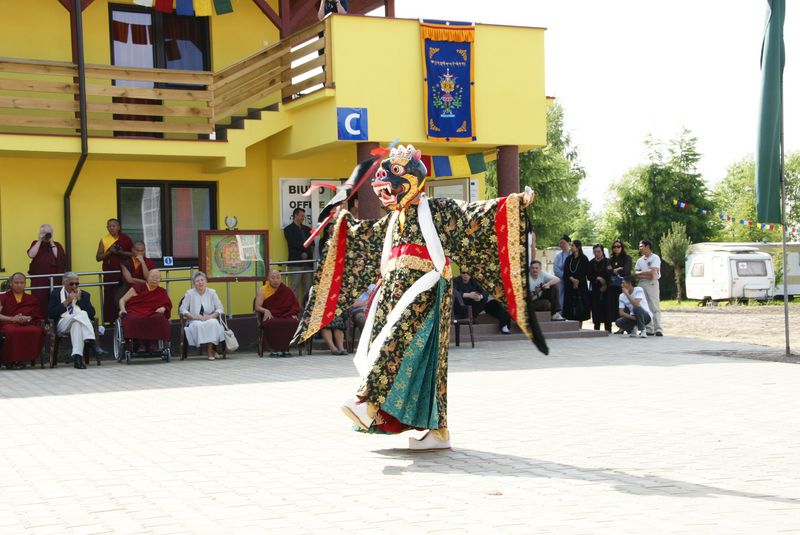
Buddhist Culture Centre
The construction of the Buddhist Culture Centre was completed in Grabnik in 2010 thanks to co-financing from the EU Fund for Regional Development. The building houses a multifunctional hall with audiovisual equipment, a library with a reading room and internet access, a terrace, as well as offices and toilets for guests. The building is adjusted to meet the needs of the disabled.
The Buddhist Culture Centre was officially inaugurated on 18th June 2010.
The event was officiated by Venerable Tenga Rinpoche and attended by His Excellency the Ambassador of India, the President of the Helsinki Foundation for Human Rights, the Director of the Asia and Pacific Museum, the Mayor of Grodzisk Mazowiecki, as well as representatives of the Tibetan and Vietnamese communities in Poland and local residents.
The inauguration was accompanied by an exhibition of sacred objects, ritual offerings: the so-called tormas embellished with intricate, traditional decorations made from butter, and a picturesque dance of Shing Kyong, the protective deity of the Benchen Monastery.