- ZWIĄZEK BUDDYJSKI BENCIEN KARMA KAMTSANG POLSKA
-

- Benchen Karma Kamtsang Buddhist Association Poland



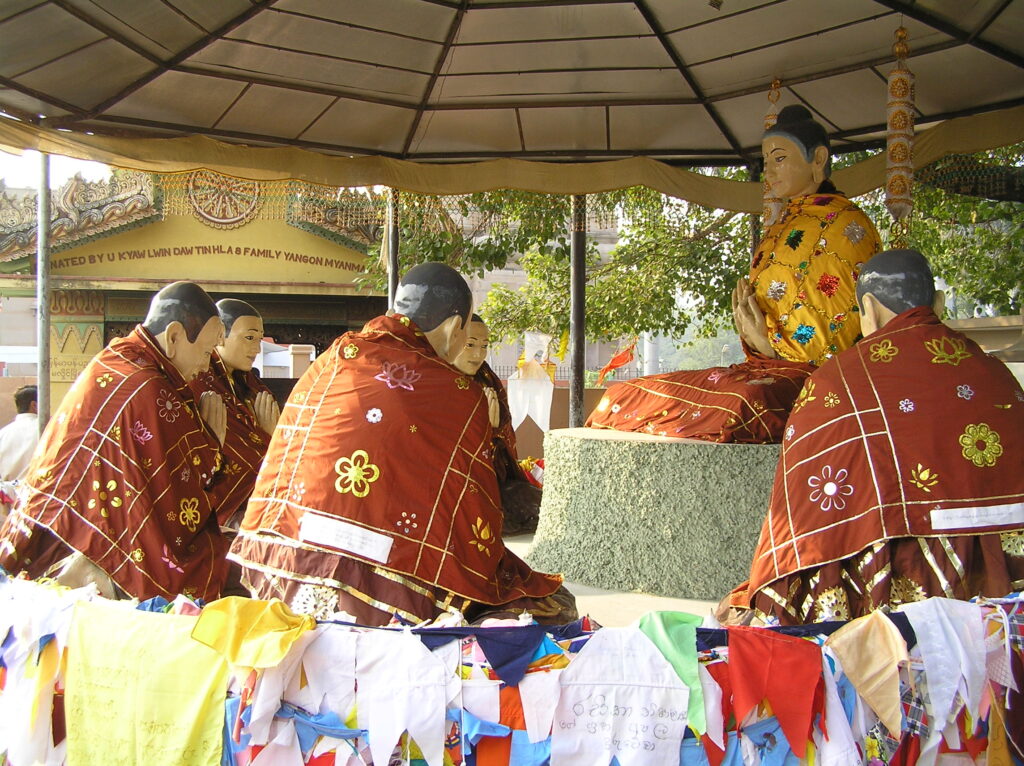
Siddhartha Gautama’s Path to Awakening
Siddhartha Gautama, a historic Buddha known as Shakyamuni (the sage of the Shakyas), was born in the 6th century B.C.E. in the royal clan of Shakya in North India.
The prince was brought up in real royal abundance. All his wishes and desires were fulfilled. He received an extraordinarily versatile education. Since his youngest years, he exhibited unusual skills and talents, both mental and physical. It seemed he should have been the happiest of all people: young, healthy, rich, and adored by everyone.
Yet his peace was disturbed by fundamental existential questions. Why do people get sick and die? How can one find solace in pleasures when one knows that they will pass, and eventually, we will all experience suffering, pain, and death? All people want to be happy, no one wants to suffer, and everyone constantly strives to avoid what is painful. But by looking for the causes of suffering and joy only outside, no one has found a way to truly free themselves from all worries and achieve lasting happiness.
As a result of these persistent thoughts Prince Siddhartha, when he was twenty-nine years old, renounced his kingdom and embarked on the search for Truth. He chose a life of a wandering ascetic, following the examples of many similarly restless minds of his times. He started with the study of yoga and Brahmin philosophy. He later practised severe asceticism for several years. Yet he still hasn’t reached his goal. At thirty-five years old he came to understand that neither extreme indulgence in pleasures nor exhausting asceticism were the right paths. He then entered the “Middle Way,” which remains the guiding principle of life for millions of Buddhists to this day.
After a period of intense contemplation, he pierced through the last veils of ignorance. He realised that both true happiness and suffering are states of mind and that external conditions are only secondary circumstances, conducive to joy or suffering. Is not the world full of rich, healthy, and yet unhappy people? Do we not know of happy poor people? He also understood that our own conduct determines what kind of conditions we will find ourselves in in our next life, and that our present health or wealth is the result of deeds performed in past lives.
Prince Siddhartha Gautama attained Awakening. He became the Buddha, or the Awakened One. This happened, according to traditional accounts, under a bodhi tree in a place called Bodh Gaya, in India.
For the first seven weeks after his Awakening, the Buddha spoke to no one about his realization. But when his former friends, seeing the majesty and splendour that emanated from him, asked him to share with them what he had discovered, he saw no reason to refuse them. For the next forty-five years he continued to teach, and the number of those who turned to him for spiritual guidance grew steadily.
Buddha passed on his knowledge and experience to others only when he was asked to do so. This lack of missionary activities remains a rule of conduct for all Buddhist teachers even today. One does not speak of the Teachings to those who have no intention of listening, but one also cannot refuse those who do want to listen.
The historical Buddha Shakyamuni left his body at the age of eighty, leaving behind a large number of disciples and a great spiritual legacy that for centuries has had a huge influence on the development of many of the world’s nations and remains a living religious tradition for hundreds of millions of people around the globe.
Essential Elements of the Buddha’s Teachings: Four Truths
- The truth about the existence of suffering
- The truth about the origin of suffering
- The truth about the cessation of suffering
- The truth about the path leading to cessation
1. The truth about the existence of suffering
The first of these truths is the statement that life is inextricably linked with suffering. Suffering is understood as any unpleasant experience, from physical pain to the most subtle lack of satisfaction and fulfilment. Thus, the teachings distinguish three kinds of suffering: the suffering of suffering, the suffering of change and all-pervasive suffering.
– The suffering of suffering manifests itself in the obvious form of pain and is like rotten rice. No one wants to eat it. And yet we go through the pain of birth, sickness, old age and death. What’s more, we cannot avoid separation from those who we would like to stay close to. We have to meet those whom we would rather avoid. We cannot get everything we want nor get rid of everything that bothers us.
– The suffering of change manifests itself in the present moment as pleasure and is like well-cooked rice mixed with poison. First, it tastes good and later on brings pain. Although we experience many joys in life, none of them lasts forever. We strive towards a certain goal, and when we finally achieve it, it does not give us lasting satisfaction. We accumulate various goods, and when we finally have them, first we have trouble with guarding them, and then we lose them anyway – at the latest at the moment of death. We constantly crave something new and this lack of complete fulfilment, although it can be very creative, is also painful.
– The suffering of existence is like unripe rice. We do not know its taste yet, because our sensitivity is dulled by the experience of pain or pleasure, which will later turn into pain. However, the very fact that we exist as living beings attracts other kinds of suffering to us. That is why existence itself is suffering.
In other words, we cannot achieve true happiness only by striving to seize pleasures and to avoid what’s painful. Building your future on fleeting joys is similar to building a castle on ice.
Nevertheless, if we were to conclude from this first Buddha’s teaching that Buddhism is a pessimistic religion we would be deeply mistaken. Buddha only drew attention to the fact that the kind of life that solely comes down to the consumption of pleasures and escaping pain is not satisfactory. Then he pointed to the causes of this state we are in as well as the possibility of overcoming suffering. Unless we realise that we are sick, we won’t make any attempts at treatment. Hence, just like a doctor does, Buddha begins with the diagnosis of illness – the suffering that forever torments us – and subsequently prescribes the medicine: the spiritual path that removes both the illness and its cause.
2. The truth the origin of suffering
The second truth explains the causes of suffering. If we have a sliver stuck in our hand it wouldn’t be wise to just take painkillers. The splinter that causes the pain needs to be removed. It is the same with suffering: it could be removed only when its true cause is known. The Buddha taught us that everything that we experience right now is the result of our current actions. The righteous deeds lead to happiness, the wrong ones bring suffering. If we put our hand into the fire, we would know straight away it wasn’t a sensible thing to do.
However, when the cause and effect are separated in time we might not always be able to draw appropriate conclusions. We are reborn again and again in new bodies and we don’t remember what we did in past lives. That is why we don’t understand the correlation between our past actions and our current suffering or happiness. When the Buddha attained Awakening he noticed how the law of cause and effect works. Hence, he taught that the cause of all suffering that we experience is our wrongdoings.
Even when we know, however, that our conduct might not be exactly right, we tend to be so blinded by attachment, anger or other poisons that we cannot stop ourselves from committing these nonvirtuous actions. Sometimes driven by fear or incorrect understanding we are not able to do the right thing even if we feel that is something that we should do. Therefore we can conclude that the main cause of negative actions is harmful emotions. They in turn have their source in our ignorance.
We don’t understand who or what we are in the ultimate sense, we don’t understand the true nature of reality in which we live nor the true nature of the relationships between ourselves and the world. This lack of understanding is the reason why we are stuck in the false hope that if we surround ourselves with one type of objects and situations and reject others, we will experience happiness and be protected from suffering. This is where the habit of clinging to one type of objects and rejecting the others comes from, and through that habit, we cultivate in ourselves negative emotions such as desire, aversion etc. Under their influence, we perform nonvirtuous acts which bring negative karmic results in the form of suffering.
And so the circle closes. We call it samsara, the cycle of conditioned existence.
3. The truth about the cessation of suffering
The first two truths describe the situation of ordinary people who desire well-being and want to avoid suffering, but because of their ignorance, they are never able to achieve truly lasting happiness nor completely free themselves from problems.
In the third truth, Buddha introduces the most joyful point of his Teaching: we can put an end to suffering! And he himself is an example that you can change your life and attain a state of complete happiness – total freedom from suffering.
Each being can attain this goal, called the Buddhahood. This hope is the reason why, although Buddhists teach a lot about suffering, they are characterized by exceptional optimism, joy, and a sense of humour. It is clearly noticeable in various Buddhist nations.
The Awakened One taught that all beings have the inherent potential of Buddhahood which they are not aware of because of their strongly rooted habitual tendencies, ignorance and destructive emotions. However, if these defilements are removed from the mind, its awakened nature will manifest.
Buddhahood means the complete annihilation of anger, desire, pride and jealousy and the cessation of all suffering, which is why it is sometimes compared to blowing out a candle flame. However, external observers of Buddhism often draw false conclusions from this, claiming that Buddhism is a nihilistic religion. They do not see, or do not want to see, those passages in the Buddhist scriptures that describe at length the state that occurs when the mind is purified of all defilements, when its inherent qualities, such as boundless love, compassion, omniscience, and other of the Buddha’s innumerable qualities, can finally manifest without any hindrance.
4. The truth about the path to liberation
Even though all beings have the innate Buddha nature, they are not aware of it. Defilements of mind do not go away on their own and nobody becomes a Buddha by accident. Only by applying certain spiritual practices can one overcome all kinds of obscurations and realise the true nature of the mind, that is, attain Buddhahood.
The path of spiritual growth in Buddhism consists, on the one hand, of purifying the body, speech and mind of all negative tendencies, and, on the other hand, of developing positive qualities such as wisdom, love and compassion towards all living things.
The practice of Buddhism comes down to three essential elements: right conduct, calm-abiding, and deepening understanding (see more in: Buddhist practice in our tradition).
When speaking about the Buddha’s teaching, it is worth explaining in more detail two concepts that in our culture are inseparably associated with the beliefs of the East, and at the same time are often misunderstood. These are: “the law of causes and effects” (sometimes called in the West “the law of karma” or simply “karma”) and “incarnation”.
As Buddhists, we believe that at death we part with our current body and at some point after that we are reborn again in one of the six realms. We might not necessarily be reborn as a human being, we can more easily fall into hell or be born as an animal. We can also become a long-lived heavenly being and wallow in the delights of one of the paradises – for a while, of course. Such an existence always ends in death and another birth. That is until we free ourselves from the cycle of samsara, cyclic existence.
In Buddhism, there are many teachings describing the six realms of existence, as well as the intermediate state (bardo) that comes after death and lasts until the next rebirth. For a Buddhist, it is especially important to explore the causes that drive the wheel of birth and death and to learn the methods by which one can break this constant cycle and free oneself from samsara, attaining Buddhahood.
However, until we attain ultimate liberation, it is very important to understand that each of our subsequent rebirths is not accidental, but depends strictly on what we did in previous lives. Now we are born as a human being, thanks to the maturation of our positive actions in the past, but we have no guarantee that the next incarnations will be equally favourable.
And here we come to the “law of cause and effect,” which tells us that everything, literally everything that happens in our lives has its cause in our previous actions, even if we performed them a long time ago in former incarnations and have no memory of them now. Similarly, what we do now, at this moment, in this life, builds the foundations – either good or bad – of our next rebirth. Thus, the teachings of karma tell us that there is no randomness in what happens to us and that at every moment we are planting seeds whose fruits we will inevitably reap in the future.
The basic misunderstanding of these teachings, also found among practising Western Buddhists, is the fatalistic interpretation of karma: since everything is the result of karma, it doesn’t matter what I do, because I will experience what is karmically destined for me. This is not the case! The teachings on karma do not contradict the fact that at every moment we have a choice as to how we want to react to what happens to us. Through these choices, we shape our future.
Suppose we find ourselves in a certain situation and have certain tendencies – for example, we meet someone who says unpleasant things to us and makes us angry – this is indeed the result of our karma, but this is where it ends. At this point we have a choice to make: to act on our rising anger, to respond in an equally unpleasant way or even throw punches– then in the future we will encounter similar or even worse situations as the karmic result of our current behaviour. But we can also try to control ourselves, decide to practice patience, and although anger arises, we do not show it in words or actions, responding kindly and gently. In this way, we sow the causes of future happiness.
People generally give in to their tendencies and emotions without thinking, and then, when they experience the consequences, they say with resignation, “This is my karma.” Such an attitude only comes from a misunderstanding of the teachings.
However, it is true that in our present confused state of mind it is difficult for us to make conscious choices. It is only as we begin to meditate that gradually more and more mental freedom arises, as well as the possibility of choice, the ability to more consciously direct both this life and future lives by sowing good or bad seeds through our own actions.
Lama Rinchen