- ZWIĄZEK BUDDYJSKI BENCIEN KARMA KAMTSANG POLSKA
-

- Benchen Karma Kamtsang Buddhist Association Poland



Buddhism in India
For many centuries, three main branches of Buddhism—Theravada, Mahayana, and Vajrayana—developed in India simultaneously. Often, Theravada and Mahayana monasteries and temples were located near each other, and sometimes followers of both traditions even lived together in the same monastery.
However, in the early centuries of the Common Era, Mahayana began to dominate in Northern India. It spread to China, and later to Korea and Japan, thus often being referred to as Northern Buddhism.
At the same time, Theravada became well-established in Sri Lanka, Myanmar, Thailand, and other countries of the Indochinese Peninsula. It is therefore called Southern Buddhism.
In the middle of the first millennium, Mahayana reached its peak in India. Huge monastery-universities were established, some of which were massive in scale. For instance, the most famous of them, Nalanda, accommodated around ten thousand students.
In accordance with the requirements of this education system, there was one lecturer for every ten students, and the monastic library contained around one hundred thousand volumes! Numerous records indicate that matters of monastic discipline were studied with the same meticulousness as Vajrayana texts, since many of the greatest proponents of tantra resided there.
Among the most renowned tantric monasteries were Vikramashila and Pullahari. They were not only centres of study but also places devoted to meditation and the observance of traditional rituals. It was there that Tibetans came to study, at the end of the first and the
Soon after, Muslim invasions and the actions of certain Hindu rulers led to the decline of Buddhism in India. While it remains the dominant religion in many other countries to this day, it never regained its former glory in India.
Buddhism in Tibet
The first wave of Tibetan interest in Buddhism occurred in the seventh and eighth centuries. Although Tibetan kings had earlier tried to introduce it into their country, the establishment of Buddhism was only made possible during the reign of King Trisong Detsen. He invited the abbot of Nalanda Monastery, Shantarakshita, and, at his advice, the eminent Vajrayana master, Guru Padmasambhava. Their joint efforts led to the spread and rooting of Buddhism in the Land of Snow.
According to the Buddha himself, his teachings would endure as long as there were Buddhist monks. Therefore, in Tibet, the introduction of Buddhism is considered to have taken place with the completion of the first monastery and the ordination of the first monks.
However, King Langdarma, who ruled in the ninth century, became a staunch opponent of the Dharma. His harsh repression led to the near-total extinction of the Buddha’s teachings in central Tibet.
After the King’s death, attempts were made to restore Tibetan Buddhism’s former glory, but much of the knowledge had been lost, and there was disagreement about how to interpret the teachings that had survived. It is believed that Tibetan Buddhism was in a state of great confusion during that time.
In the eleventh century, a religious revival took place. More Buddhist teachers were invited to Tibet from India. Among them was Dipamkara Atisha, the most prominent master of his time, and abbot of the main temple in Bodh Gaya.
The twelve years he spent in Tibet were crucial in shaping the form of Tibetan Buddhism as we know it today. It was Atisha who popularised a style of practice that integrated ethical principles, as in Theravada, with Mahayana teachings on the integration of understanding of emptiness with compassion, and the Vajrayana methods that allow one to progress and realise what the Mahayana teachings describe. Atisha also gave final form to the monastic rules in the Land of Snow.
Kagyu School and Karma Kamtsang
During this period, many Tibetans travelled to India to study the Buddha’s teachings. Under the guidance of Indian scholars, they translated many works into their native language and, upon returning to Tibet, became teachers themselves.
One of the most prominent travelers and translators was Marpa Lotsawa. He made three perilous journeys across the Himalayas to study with masters like Naropa and Maitripa. It is from him the tradition known as Kagyu originated.
Among Marpa’s disciples, the most famous one was Milarepa. He was unmatched in his devotion to his master and determination to dedicate himself to a truly renunciative meditation practice. He presented his teachings in the form of songs. Their anthology, known as “One Hundred Thousand Songs of Milarepa”, have been translated into many languages and are considered one of the greatest works of world literature.
Milarepa’s spiritual successor was Gampopa. He was a monk trained according to the tradition introduced by Atisha, meaning he was well-versed in monastic traditions as well as the teachings of Mahayana and Vajrayana. However, from Milarepa, he received the transmission of the exceptional practices that Marpa brought to Tibet.
The fusion of these two traditions gave final form to the Kagyu school, which, since the time of Gampopa, has become one of the most influential schools in Tibet. The other schools are Nyingma, Sakya, and Gelug. The essence of their teachings is the same; differences arise due to historical circumstances and emphasise different aspects of the Dharma.
Gampopa had many disciples. They established several sub-schools within the Kagyu tradition. One of the most significant among them is Karma Kamtsang, also known as Karma Kagyu. The first part of the name comes from the name of the Karmapa – the foremost among Gampopa’s disciples.
Reincarnations and the Tulku System
The concept of continuous rebirth is one of the most fundamental Buddhist teachings. An ordinary being has no direct influence over the time and place of their future rebirth. The force of previously accumulated positive and negative actions propels them toward a particular rebirth. However, spiritually developed beings have the ability to consciously choose their rebirth in order to fulfill their Bodhisattva vow and work for the greatest benefit of all sentient beings.
The recognition of certain individuals as incarnations of great masters was known much earlier in India and other Buddhist countries. The innovation brought by the Tibetan system of finding tulkus, or consciously reincarnated lamas, is the practice of identifying exceptionally gifted children and providing them with careful, individualised education from an early age.
For example, the first Karmapa left a letter before his death predicting the details of his future birth. He continued to do this in subsequent incarnations, thus maintaining the oldest line of conscious reincarnations to this day.
Over time, the system of recognizing tulkus became established in all schools of Tibetan Buddhism. However, the ability to predict one’s future rebirth is something exceptional. Other tulkus are discovered through the visions and guidance of lamas such as the Dalai Lama or the Karmapa.
Looking at the history of Tibet, or even at contemporary tulkus such as His Holiness the 14th Dalai Lama or His Holiness the Karmapa, one can conclude that in the vast majority of cases, this system has proven to be highly effective. The recognized incarnations, in addition to their personal names, usually take the name of the tulku lineage and are honoured with the respectful title of “Rinpoche.”
The most well-known lama in the world is undoubtedly His Holiness the Dalai Lama, regarded as the fourteenth conscious incarnation. Although traditionally associated with the Gelugpa school, he received thorough education in all four schools of Tibetan Buddhism. While there are no formal hierarchical structures between Buddhist traditions from different countries, His Holiness the Dalai Lama is widely regarded as the leading representative of Buddhism as a whole.
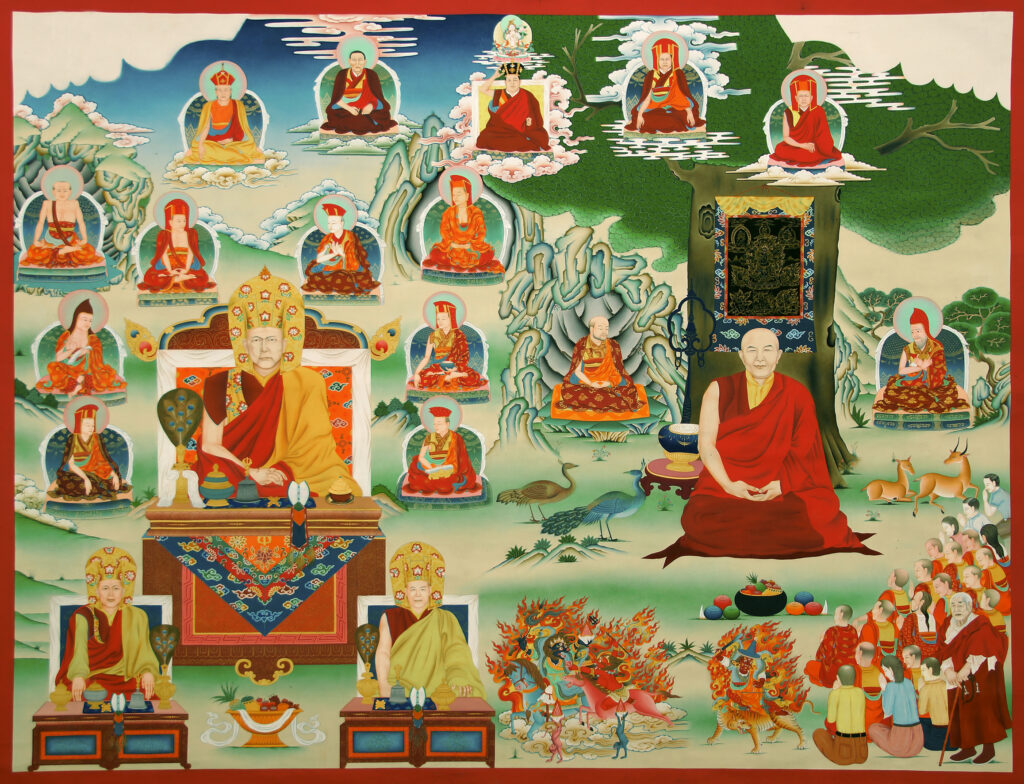
His Holiness the Karmapa is the head of the Karma Kagyu school. Between each of his incarnations, the holders of the lineage have always been prominent and highly realized lamas. Some of them have even created their own lines of incarnations. These successive links in the Karma Kamtsang lineage, including both the Karmapas and the lineage holders between them, form what is known as the Father-Son Lineage, also called the Golden Rosary of the Kagyu Lineage.
The preservation and development of the Karma Kagyu school have been particularly supported by tulku lines such as Shamarpa, Situpa, Jamgon Kongtrul, Tsurphu Gyaltsab, Sangye Nyenpa, and Pawo. Among them, Sangye Nyenpas, as the heads of the Benchen Monastery, are inextricably connected with our monastery.
Benchen Monastery Tradition – see Benchen Monastery.
Lama Rinchen